

Hey there! As a supplier of Flat Head Rivet Nuts, I often get asked about all sorts of technical details. One question that pops up quite a bit is, "What is the Poisson's ratio of flat head rivet nuts?" Let's dive right into it.
First off, let's talk about what Poisson's ratio actually is. In simple terms, Poisson's ratio is a measure of how a material behaves when it's stretched or compressed. When you pull on a piece of material, it usually gets thinner in the directions perpendicular to the pull. Poisson's ratio is the ratio of the transverse strain (the change in thickness) to the axial strain (the change in length). It's a dimensionless number, and for most materials, it falls between 0 and 0.5.
Now, when it comes to flat head rivet nuts, the Poisson's ratio depends on the material they're made of. Most flat head rivet nuts are crafted from metals like steel, aluminum, or brass. Each of these materials has its own unique Poisson's ratio.
Steel, for example, typically has a Poisson's ratio around 0.3. This means that when you stretch a steel flat head rivet nut, it'll get about one-third as thinner in the perpendicular directions as it gets longer. Aluminum, on the other hand, has a slightly higher Poisson's ratio, usually around 0.33. So, it'll contract a bit more in the transverse directions compared to steel when stretched. Brass, with a Poisson's ratio of around 0.34, falls in a similar range as aluminum.
Why does the Poisson's ratio matter when it comes to flat head rivet nuts? Well, it has a big impact on how the rivet nuts perform in different applications. For instance, in applications where the rivet nuts are subjected to a lot of tension, a material with a lower Poisson's ratio might be preferred. This is because it'll experience less contraction in the perpendicular directions, which can help prevent issues like cracking or loosening.
Let's say you're working on a project that requires a strong and reliable connection. You'd want to choose a flat head rivet nut made from a material with the right Poisson's ratio for the job. If you're dealing with high-stress situations, steel might be a great choice due to its relatively lower Poisson's ratio.
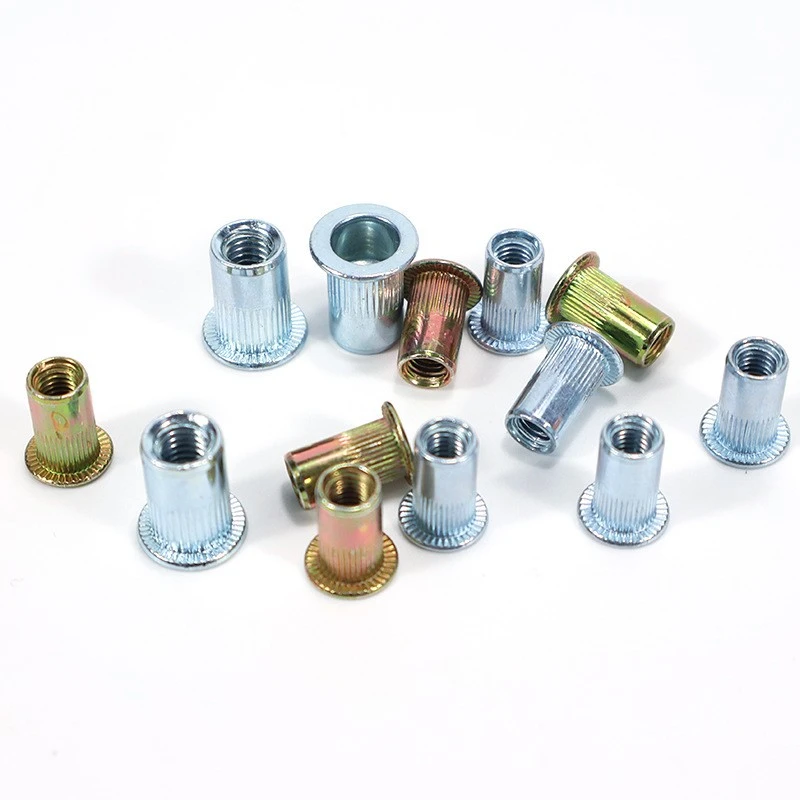

Now, besides the Poisson's ratio, there are other types of rivet nuts that you might be interested in. We offer a wide range of products, including Internal External Hex Rivet Nuts. These are great for applications where you need a secure and hex-shaped connection. They're designed to provide extra grip and stability, making them perfect for heavy-duty projects.
Then, we have Knurled Rivet Nuts. The knurled design on these rivet nuts helps to prevent them from rotating once they're installed. This is especially useful in applications where vibration or movement is a concern. They're a popular choice for automotive and machinery industries.
Cylindrical Rivet Nuts are another option. Their simple cylindrical shape makes them easy to install and suitable for a variety of applications. They're often used in sheet metal assemblies and other projects where a clean and straightforward connection is needed.
If you're looking for something with a bit more strength and stability, Full Hex Rivet Nuts are a great pick. The full hex design provides extra surface area for gripping, making them ideal for high-torque applications.
And for projects where space is limited, Small Head Rivet Nuts are the way to go. Their compact size allows them to be used in tight spaces without sacrificing performance.
So, whether you're a DIY enthusiast working on a home project or a professional in the manufacturing industry, we've got the right flat head rivet nut or other types of rivet nuts for you. Our products are made from high-quality materials, and we ensure strict quality control to guarantee their performance.
If you're interested in purchasing our rivet nuts or have any questions about Poisson's ratio or any other technical details, don't hesitate to reach out. We're here to help you find the best solution for your needs. Just let us know what you're working on, and we'll do our best to assist you.
In conclusion, understanding the Poisson's ratio of flat head rivet nuts is crucial for choosing the right material for your applications. It can have a significant impact on the performance and reliability of the rivet nuts. And with our wide range of products, you're sure to find the perfect rivet nuts for your project. So, let's get in touch and start discussing your requirements. We're looking forward to hearing from you!
References
- Materials Science and Engineering textbooks